
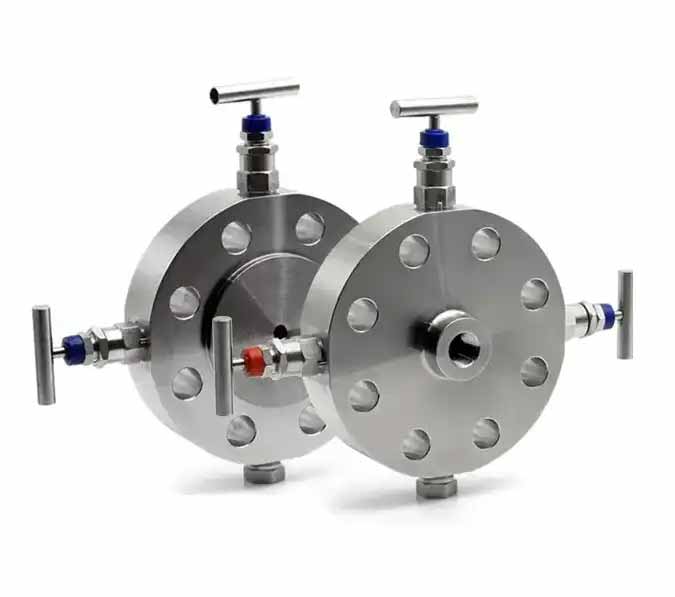
Single & Double Block and Bleed Mono Flange Valves
A mono flange valve combines a flanged process connection with one or two needle isolation valves and a vent / bleed valve in a single forged or bar stock body. It bolts straight onto a flanged pipe nozzle and gives a threaded outlet for a pressure gauge, transmitter or sampling line.
It replaces the traditional arrangement of a flanged gate or globe root valve followed by a separate needle valve and fittings. The result is far less weight and length on the nozzle, fewer threaded joints that can leak, and a hook-up that fits into tight spaces on skids and offshore modules.
- Lower weight, shorter length
- Fewer potential leak paths
- ASME B16.5 flange drilling
- Needle-type isolation & bleed
- RF or RTJ facing
- NACE & oxygen service options
Mono Flange Valve Types
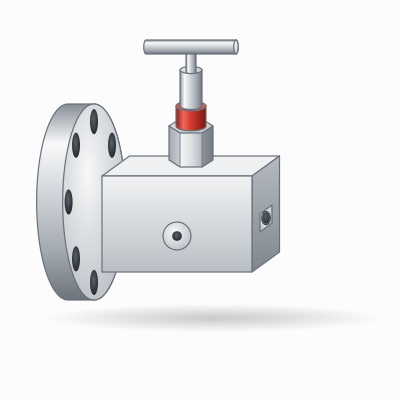
Single Block & Bleed
One needle isolation valve between the flange and the instrument outlet, plus a bleed valve to vent the instrument side. Suited to pressure gauges, switches and transmitters on general process duties where a single isolation barrier is acceptable.
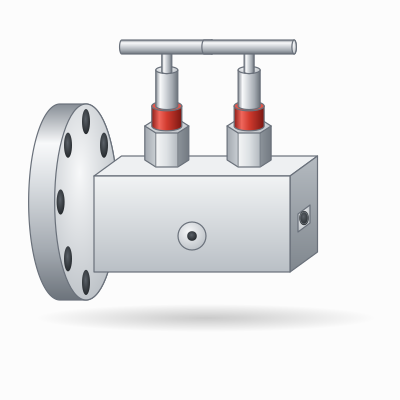
Double Block & Bleed
Two isolation valves in series with a bleed valve between them. With both blocks closed, the cavity is vented to prove positive isolation before the instrument is removed — the arrangement specified for hydrocarbon, toxic and high pressure service.
Technical Specifications
| Product | Mono Flange Valves — Single Block & Bleed, Double Block & Bleed |
|---|---|
| Flange Size | 1/2", 3/4", 1", 1-1/2", 2" |
| Pressure Class | 150#, 300#, 600#, 900#, 1500#, 2500# |
| Flange Standard | ASME B16.5; others on request |
| Flange Facing | Raised Face (RF) standard; Ring Type Joint (RTJ) on request |
| Instrument Connection | 1/4" to 1" NPT / BSP female & others on request |
| Vent / Bleed Port | 1/4" or 1/2" NPT / BSP female |
| Max Working Pressure | 3000 / 6000 / 10000 PSI valve rating, limited by the flange class and temperature |
| Isolation Valve | Needle type, rising stem, non-rotating tip, back seated |
| Packing | PTFE (standard), Grafoil, PEEK |
| Body Materials | SS 304, SS 316, SS 316L, Inconel, Monel, Hastelloy C & others on request |
| Options | Oxygen service cleaning, NACE MR0175 / ISO 15156, PMI, TPI, Grafoil & PEEK packing |
| Testing & Certificates | Hydrostatic shell & seat test, EN 10204 3.1 material certificate, third party inspection on request |
Material Grades
Stainless Steel
Nickel Alloys
| Material | UNS No. | Bar Stock | Forgings |
|---|---|---|---|
| SS 304 | S30400 | ASTM A479 / A276 | ASTM A182 F304 |
| SS 316 | S31600 | ASTM A479 / A276 | ASTM A182 F316 |
| SS 316L | S31603 | ASTM A479 / A276 | ASTM A182 F316L |
| Monel 400 | N04400 | ASTM B164 | ASTM B564 |
| Inconel 600 | N06600 | ASTM B166 | ASTM B564 |
| Inconel 625 | N06625 | ASTM B446 | ASTM B564 |
| Hastelloy C-276 | N10276 | ASTM B574 | ASTM B564 |
Chemical & Mechanical Properties
| Grade | C | Mn | Si | P | S | Cr | Ni | Mo | Others |
|---|---|---|---|---|---|---|---|---|---|
| SS 304 | 0.08 | 2.00 | 1.00 | 0.045 | 0.030 | 18.0–20.0 | 8.0–10.5 | — | N 0.10 |
| SS 316 | 0.08 | 2.00 | 1.00 | 0.045 | 0.030 | 16.0–18.0 | 10.0–14.0 | 2.0–3.0 | N 0.10 |
| SS 316L | 0.030 | 2.00 | 1.00 | 0.045 | 0.030 | 16.0–18.0 | 10.0–14.0 | 2.0–3.0 | N 0.10 |
| Monel 400 | 0.30 | 2.00 | 0.50 | — | 0.024 | — | 63.0 min | — | Cu 28.0–34.0, Fe 2.5 |
| Inconel 600 | 0.15 | 1.00 | 0.50 | — | 0.015 | 14.0–17.0 | 72.0 min | — | Fe 6.0–10.0, Cu 0.50 |
| Inconel 625 | 0.10 | 0.50 | 0.50 | 0.015 | 0.015 | 20.0–23.0 | 58.0 min | 8.0–10.0 | Nb+Ta 3.15–4.15, Fe 5.0 |
| Hastelloy C-276 | 0.010 | 1.00 | 0.08 | 0.04 | 0.03 | 14.5–16.5 | Balance | 15.0–17.0 | W 3.0–4.5, Fe 4.0–7.0 |
| Grade | Tensile Strength (MPa, min) | Yield Strength 0.2% (MPa, min) | Elongation (%, min) | Hardness (max) |
|---|---|---|---|---|
| SS 304 | 515 | 205 | 40 | 201 HB |
| SS 316 | 515 | 205 | 40 | 217 HB |
| SS 316L | 485 | 170 | 40 | 217 HB |
| Monel 400 | 480 | 170 | 35 | — |
| Inconel 600 | 550 | 240 | 30 | — |
| Inconel 625 | 827 | 414 | 30 | — |
| Hastelloy C-276 | 690 | 283 | 40 | — |
| Grade | Density (g/cm³) | Melting Range (°C) | Key Characteristic |
|---|---|---|---|
| SS 304 | 8.00 | 1400–1450 | General corrosion resistance, economical |
| SS 316 / 316L | 8.00 | 1375–1400 | Molybdenum for chloride & pitting resistance |
| Monel 400 | 8.80 | 1300–1350 | Sea water, hydrofluoric acid service |
| Inconel 600 | 8.47 | 1354–1413 | High temperature oxidation resistance |
| Inconel 625 | 8.44 | 1290–1350 | High strength, crevice corrosion resistance |
| Hastelloy C-276 | 8.89 | 1325–1370 | Severe oxidising & reducing chemicals |
Size, Flange & Parts Tables
Flange Size × Pressure Class Availability
| Flange Size | 150# | 300# | 600# | 900# | 1500# | 2500# |
|---|---|---|---|---|---|---|
| 1/2" | ✓ | ✓ | ✓ | ✓ | ✓ | ✓ |
| 3/4" | ✓ | ✓ | ✓ | ✓ | ✓ | ✓ |
| 1" | ✓ | ✓ | ✓ | ✓ | ✓ | ✓ |
| 1-1/2" | ✓ | ✓ | ✓ | ✓ | ✓ | ✓ |
| 2" | ✓ | ✓ | ✓ | ✓ | ✓ | ✓ |
| Rating at 38 °C, SS 316 (bar) | 19.0 | 49.6 | 99.3 | 148.9 | 248.2 | 413.7 |
Typical Flange Dimensions — ASME B16.5 (Reference)
| Size | Class | Flange OD (mm) | Bolt Circle (mm) | No. of Holes | Hole Dia (mm) | Bolt Size (in) |
|---|---|---|---|---|---|---|
| 1/2" | 150# | 90 | 60.3 | 4 | 15.7 | 1/2 |
| 1/2" | 300# / 600# | 95 | 66.7 | 4 | 15.7 | 1/2 |
| 3/4" | 150# | 100 | 69.9 | 4 | 15.7 | 1/2 |
| 3/4" | 300# / 600# | 115 | 82.6 | 4 | 19.1 | 5/8 |
| 1" | 150# | 110 | 79.4 | 4 | 15.7 | 1/2 |
| 1" | 300# / 600# | 125 | 88.9 | 4 | 19.1 | 5/8 |
| 1-1/2" | 150# | 125 | 98.4 | 4 | 15.7 | 1/2 |
| 1-1/2" | 300# / 600# | 155 | 114.3 | 4 | 22.4 | 3/4 |
| 2" | 150# | 150 | 120.7 | 4 | 19.1 | 5/8 |
| 2" | 300# / 600# | 165 | 127.0 | 8 | 19.1 | 5/8 |
Parts & Materials of Construction (SS 316 Valve)
| No. | Part | Standard Material | Notes |
|---|---|---|---|
| 1 | Flanged Body | SS 316 (ASTM A182 F316 / A479) | One-piece body, RF or RTJ face |
| 2 | Bonnet | SS 316 | Threaded and locked into body |
| 3 | Stem | SS 316 | Non-rotating tip, back seated |
| 4 | Gland Packing | PTFE | Grafoil or PEEK optional |
| 5 | Gland Nut | SS 316 | Adjustable packing compression |
| 6 | Handle | SS 304 | T-bar; colour-coded dust caps on request |
| 7 | Bleed Valve / Screw | SS 316 | Vents the instrument side or DBB cavity |
| 8 | Plug | SS 316 | Blanks the unused vent port |
Where Our Mono Flange Valves Are Used
Pressure Transmitter Isolation
Primary Root Valve at Flanged Nozzles
Oil & Gas Production
Offshore Platforms & FPSOs
Refineries & Petrochemicals
Chemical Injection Points
Sampling Connections
Gas Processing Plants
Features & Advantages
Lighter Nozzle Load
One compact body replaces a flanged root valve, nipple and needle valve, cutting the weight and overhang carried by small-bore nozzles.
Fewer Leak Paths
Integral valves remove the threaded joints between separate components — the most common source of fugitive emissions.
Proven Isolation
Double block & bleed design lets the cavity be vented to confirm both seats are holding before any instrument work begins.
Full Traceability
Heat numbers are marked on each body and recorded against mill certificates, with PMI and TPI available on request.
Frequently Asked Questions
What is a mono flange valve?
What is the difference between single and double block & bleed?
Which flange class should I specify?
Do you supply RTJ face or special drillings?
Related Products
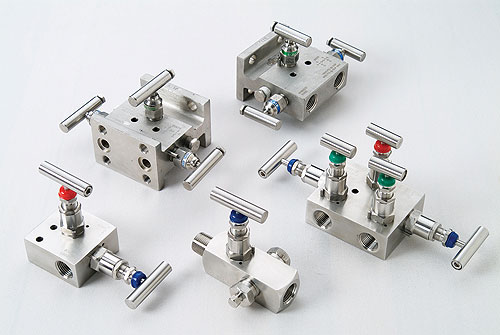 018 Types
 024 Types
 032 Types
Need Mono Flange Valves for Your Project?
Send flange size, class, facing, outlet connection and material — we will quote with drawings, material certificates and delivery schedule.